DataCamp
GoodThought NGO Data Analysis
SQL analysis of humanitarian assignments, donations, and donor activity across 13 years of PostgreSQL data
Role
Data Analyst
Team
Solo
13 years
Data coverage (2010–2023)
4
Tables in schema
2
Core analyses completed
$3,840
Top assignment donation total
Background
GoodThought NGO is a humanitarian organization focused on education, healthcare, and sustainable development. This project involved querying a PostgreSQL database covering assignments, donations, and donor activity from 2010 to 2023 to identify where funding was concentrated and which programs were delivering the highest impact by region.
Database Schema
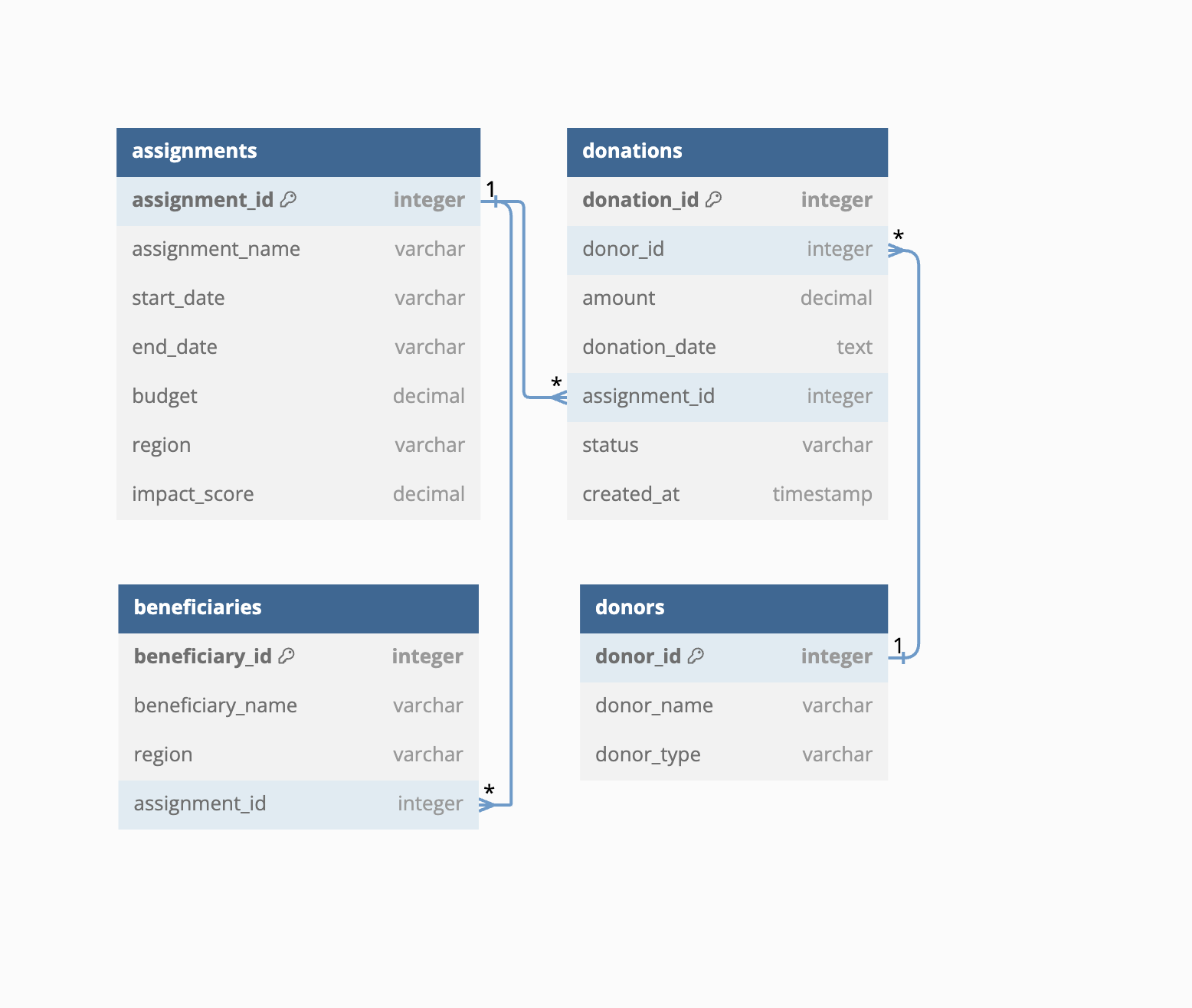
The database contains four tables:
| Table | Primary Key | Key Columns |
|---|---|---|
| assignments | assignment_id | assignment_name, start_date, end_date, budget, region, impact_score |
| donations | donation_id | donor_id (FK), amount, donation_date, assignment_id (FK), status |
| donors | donor_id | donor_name, donor_type |
| beneficiaries | beneficiary_id | beneficiary_name, region, assignment_id (FK) |
Analysis 1: Highest Donation Assignments
This query joins assignments, donations, and donors to find the top 5 assignments by total donation amount, grouped by region and donor type.
SELECT
  a.assignment_name,
  a.region,
  ROUND(SUM(d1.amount), 2) AS rounded_total_donation_amount,
  d2.donor_type
FROM public.assignments a
LEFT JOIN public.donations d1
  ON a.assignment_id = d1.assignment_id
LEFT JOIN public.donors d2
  ON d1.donor_id = d2.donor_id
WHERE d1.amount IS NOT NULL
GROUP BY a.assignment_id, a.region, d2.donor_type
ORDER BY rounded_total_donation_amount DESC
LIMIT 5;
Results:
| Assignment | Region | Total Donations | Donor Type |
|---|---|---|---|
| Assignment_3033 | East | $3,840.66 | Individual |
| Assignment_300 | West | $3,133.98 | Organization |
| Assignment_4114 | North | $2,778.57 | Organization |
| Assignment_1765 | West | $2,626.98 | Organization |
| Assignment_268 | East | $2,488.69 | Individual |
Individual donors drove the top result, but organizations account for four of the five. That split is worth noting when thinking about where fundraising effort is going.
Analysis 2: Top Regional Impact Assignments
This query uses a CTE with ROW_NUMBER() to isolate the highest-impact assignment in each region, then counts how many donations each received.
WITH max_region_impact AS (
  SELECT
    a.assignment_id,
    a.assignment_name,
    a.region,
    a.impact_score,
    ROW_NUMBER() OVER(
      PARTITION BY a.region
      ORDER BY a.impact_score DESC, a.assignment_name
    ) AS rn
  FROM public.assignments a
)
SELECT
  m.assignment_name,
  m.region,
  m.impact_score,
  COUNT(d.donation_id) AS num_total_donations
FROM max_region_impact m
LEFT JOIN public.donations d
  ON m.assignment_id = d.assignment_id
WHERE m.rn = 1
GROUP BY m.assignment_name, m.region, m.impact_score
ORDER BY m.region;
Results:
| Assignment | Region | Impact Score | Donations Received |
|---|---|---|---|
| Assignment_316 | East | 10.00 | 2 |
| Assignment_2253 | North | 9.99 | 1 |
| Assignment_3547 | South | 10.00 | 1 |
| Assignment_2794 | West | 9.99 | 2 |
High impact scores do not map cleanly to high donation counts. The programs scoring best on impact are receiving very little donor attention, which points to a resource allocation gap worth investigating.
What I Demonstrated
- Multi-table JOINs: chained
LEFT JOINacross three tables (assignments, donations, donors) to bring donor type into an aggregation starting from the assignment level. - CTEs: used
WITH max_region_impact AS (...)to separate the window function logic from the final aggregation, keeping the query readable and the intent clear. - Window functions:
ROW_NUMBER() OVER (PARTITION BY region ORDER BY impact_score DESC)ranks assignments within each region; the outer query filters to rank 1 withWHERE rn = 1. - Aggregations and rounding:
SUM()withROUND(..., 2)for clean financial figures;COUNT()for donation tallies. - NULL handling:
WHERE d1.amount IS NOT NULLguards the donation sum against null rows introduced by theLEFT JOIN.